Image credit: Freepik
Golf Plus Magazine Interview: Sport Psychology in Golf

DigitalSept20-dragged-1

Image credit: Freepik

The psychologist explains how her field of study can be used to enhance the performances of sportspersons.
In an era of unparalleled competition and high stakes, the toll on mental health has been immense to say the least. Sports personalities across the planet deal with performance pressure almost every day and if they fail at any juncture, the remedy to cope shouldn’t be limited to better your physical fitness only.
Sports psychology is the founding stone on which athletes can overcome their performance fears, anxiety issues and most crucial of them all – help them achieve greater heights by inculcating composure and renewed intensity.
Nanaki. J. Chadha whose innate passion for sports made her pursue a master’s in the field of sport psychology from Loughborough University is taking strides to make her case. Nanaki is a Sports and Performance psychologist who is nearing completion of her doctoral degree at Staffordshire University, United Kingdom, alongside awaiting confirmation of Chartership status under the British Psychological Society (BPS).
In an exclusive chat with SportsAdda.com, Nanaki whole-heartedly spoke about her initial steps in the field of sports psychology. “I was introduced to the subject of psychology when I was in the 11th grade and instantly developed a liking for the subject. I was intrigued by how the human mind functions and the impact our thoughts can have on our behaviour.”
“Having played competitive sport and experiencing its high psychological demands from a young age, I recognize the importance of mental preparedness.” Being a sports person herself, Nanaki first foray into the world of sports was when she picked up a tennis racket at the age of eight before finding her way onto golf.
“The pressures that I encountered as a budding tennis player eventually made its way onto the greens of the golf course. At my peak, I was not only ranked amongst the top ten women amateur golfers in a country of billions but was also part of the Indian National Squad.”
She recalled how the unavailability of a sports psychologist at the time to help her overcome her fears was what made her to decide to pursue this field.”In order to fill this apparent void in the sporting ecosystem, I decided to merge my passion for sport and psychology and give back to the community,” she revealed.
Nanaki further explained that sports psychologists study athletes’ thoughts, emotions and behaviours and employ ways to enhance their performance and well-being on the field by providing effective solutions. Currently, her research focuses on the examination and application of Rational Emotive Behaviour Therapy (REBT) in performance setting such as sports.
“I personally feel that REBT can help all of us to think in a more rational, logical and pragmatic manner, thus, promoting performance and well-being.”
During her five year stay in the United Kingdom (U.K.), Nanaki worked with athletes from the grassroots level to ones playing at both national and international levels across sports like cricket, golf, football, hockey, athletics, gymnastics, swimming, rowing, rugby, water polo, and taekwondo. “I worked with multiple national and international sporting organisations, including the Indian Golf Union (IGU), Talented Athlete Scholarship Scheme (TASS), Northamptonshire County Cricket Club, City of Stoke Athletics Club and Staffs Elite Programme.”
Recollecting her session with a nine-year-old swimmer in the U.K., Nanaki came across a unique challenge of communicating her methods in a simplistic manner to a young and budding athlete but was happily astonished after a spell of positive results.
“I had concerns such as “will the athlete be able to comprehend and apply the intervention effectively in her practice? But as the sessions progressed, the athlete revealed that she was not only able to apply the principles of sport psychology to her sport but also used it in her day to day life, especially in pressure situations at school.”
Given the scope of challenges that athletes face in their life, Nanaki stated that her field of study can help these sports persons overcome lack of self-confidence, intense competitive stress and emotional turmoil that may cloud their judgment. The attitude of ‘Winning is everything’ adds unnecessary pressure which indirectly takes course as a performance killer, can be avoided through sports psychology.
Adding a qualified sports psychologist to organizations and accepting the idea of sports psychology is what Nanaki believes will bring the change in the future. “In the next 10 years, I hope and would like to see sport psychology getting its due importance in all sports across the country and integrating it into the athlete’s daily training routine.”
Nanaki is one of the few candidates who is emerging as a flag bearer for implementing effective methods of sports psychology to improve performances of sports personalities. Success and nothing less for the lady whose eventful journey will inspire the future breed of budding psychologists in the country.
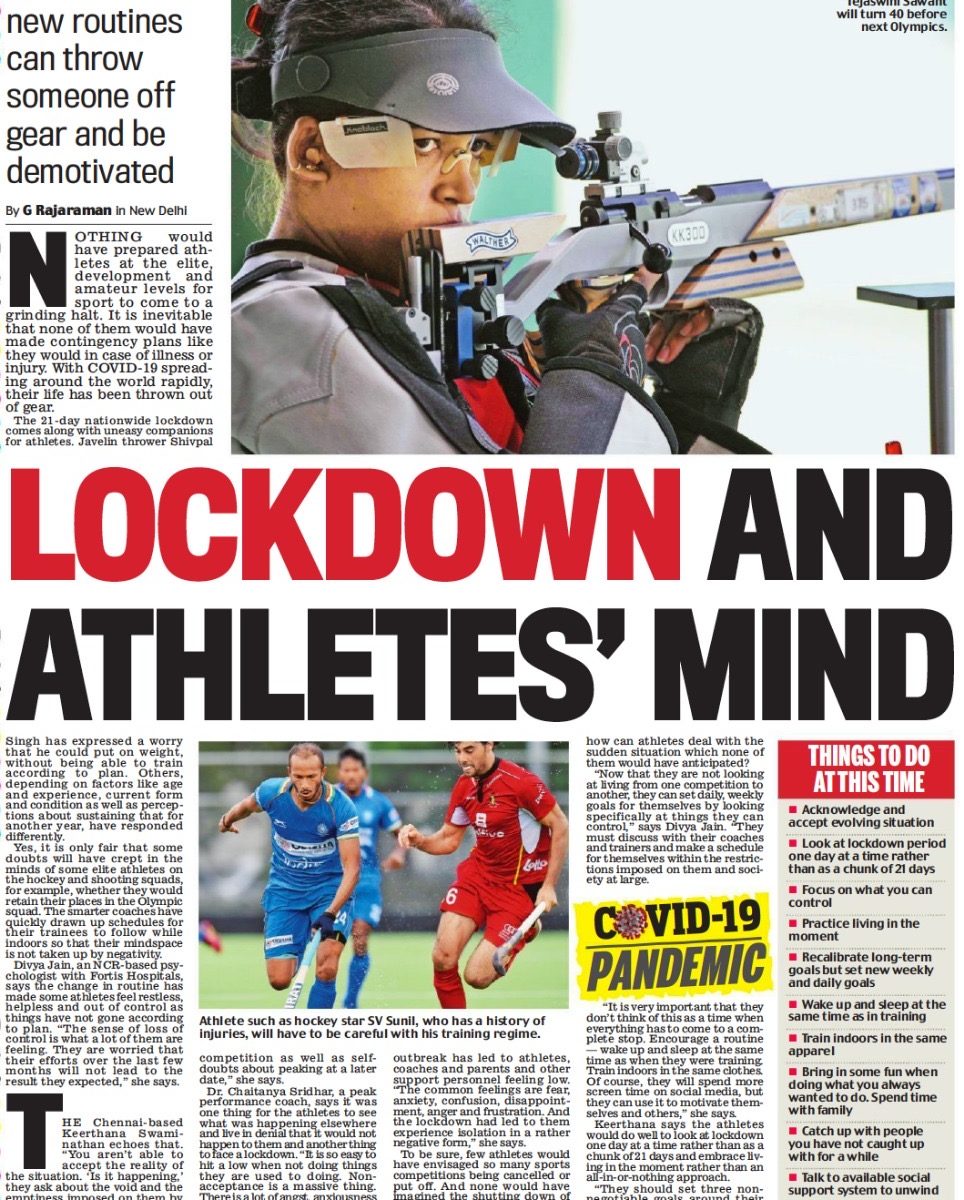
Uncertainty is so intrinsic to sports that elite athletes will not have much trouble coping up with a pandemic-forced lockdown, feel India”s top sports psychologists as they become a part of their journey into an unchartered territory.
Rocked by the COVID-19 pandemic, which has impacted minds as much as health and productivity, sports pychologists Dr Chaitanya Sridhar, Nanaki J Chadha, and Keerthana Swaminathan are dealing with athletes across disciplines and economic spectrum, being their “sounding board, friend” and enabling them to process the magnitude of the situation.
“When you are dealing with athletes, you can broadly divide them in three categories — the elite, the ones who are at national level aspiring to make it and the next group is academy bunch. The reaction to lockdown will be different,” said Dr Sridhar, who is associated with JSW Sports and has worked with ”GoSports” Foundation and IPL franchise RCB.
For performance analyst and sports psychologist Nanaki, this is the time when “you help them steer clear of negative thoughts.”
For Keerthana, there is light at the end of the tunnel where a lot of athletes, who probably had injuries or may have been going through slump in form, get a chance to “recuperate both physically and emotionally” in the time away from sport.
But yes, there is also the disappointed lot, which was hitting the peak in what was to be an Olympic year.
“As a psychologist, it breaks my heart to see those who were really peaking before the big tournament. They are the ones likely to be disappointed more. But I am a big believer in Rahul Dravid”s statement: ”Control the controllables”.”
Sridhar said reactions of various athletes vary — from being overtly positive to that of denial accompanied by mood swings and anger.
“These are people who are accustomed to movement, so all your dopamine, serotonin, all feel good hormones are reduced as you are not on the go. Even if you have a big house, how much can you train?” Dr Sridhar spoke about the technical aspect.
“We have a tendency to jump into worst-case scenario, like ”Oh my god” and the constant feeling is ”what if, what if, what if”. The first weekend was like, some of these guys were so much on the road, they were like okay, we have finally got some time with our families.
“By the second week, it starts hitting them that what lockdown is all about,” she said while narrating her interactions with wrestlers under the aegis of JSW.
Nanaki, who is a doctoral and research student at the Staffordshire University in the United Kingdom, said that challenge for any psychologist is to convince the athlete that negative thoughts are not real.
“Negative thoughts are not reality. They are just thoughts. But yes, the performance anxiety is very real. You lose focus and sense of purpose.
“”I was preparing for this event and now what”s next? Will I be able to perform?” Emotions are stress and anxiety. Isolation is also a big thing,” she said.
So how does he deal with it?
“I just drop in a text to check if they are doing alright. I tell them I am there if they need me. I also tell them to involve in some other activities, have a different vocation,” Nanaki added.
Having a different vocation is something that even Dr Sridhar feels can be very helpful.
“One of the athletes told me ”Ma”am, I am learning how to play piano online”. I found it heartening. But I get worried with those athletes who are always trying hard to be positive. Now that”s the problem with our Indian system.”
“This ”be positive” has reached such a cliched space that we have stopped acknowledging our feelings.
“So for these athletes who use the ”be positive cliche” to hide their vulnerability, I say, not required. Be vulnerable, it”s natural. It helps you process emotions better,” Dr Sridhar added.
Keerthana feels the “acceptance of uncertainty” comes with another aspect.
“You have to regroup and re-calibrate your goals. Think that you have had a career-threatening injury and you are on a road to recovery. You are taking that time and preparing for the Olympics now that it has been pushed by a year,” she said.
Dr Sridhar cited an interaction with a swimmer to drive home the point.
“One swimmer came to me and asked, ”Ma”am what if I don”t qualify for Olympics?” I just asked ”Would you stop swimming if you don”t qualify?” The answer was ”No”. I told him you have the answer.”
This is also time when exposure to social media can be distressing especially for a top sportsperson with a lot of following.
“I don”t make much of social media posts. Yes, you put up posts for fans, people are liking, but don”t rely on that. It is very good time to reflect, on your values, where you are heading, what”s working and what”s not working in your life.
“Just don”t sit on playing PUBG and remain hooked to Facebook and instagram, scrolling posts. Your brain will just be dead. Learn something to stimulate your mind.” PTI KHS PM PM PM

It will be an understatement to say that India missed two of its best sports performers, javelin thrower Neeraj Chopra and gymnast Dipa Karmakar, at the world championships of their respective sport this month. They are on a rehabilitation timeline, recovering from injuries that needed them to undergo surgeries – Neeraj on his right elbow and Dipa on her right knee.
From the distance, their current mindsets are as vastly different as their sports. Neeraj Chopra was reportedly keen to compete in the IAAF World Atheltics Championships in Doha while Dipa Karmakar did not take part in the trials to select the team, aware that her recovery process has remained incomplete. Make no mistake, both want to be on the rebound and in competition.
It is hard to say how much help either has received in terms of training their mind to bounce back stronger from injuries. But it is not surprising that Delhi-based sports psychologist Divya Jain of Fortis Healthcare says only a small percentage of her clients are those seeking psychological support during rehabilitation after an injury and a surgery.
So, what could be going through the minds of top Indian athletes who are in different stages of rehabilitation after surgery? Ideally, it is athletes who provide answer to the questions. Nanaki J Chadha, a former top 10 player on the Indian Golf Union charts and now a sports psychology researcher, says a lot of irrational thoughts can dominate the mind.
“Injuries are a traumatic, unpleasant experience for any athlete. For, an injury impacts an athlete mentally quite a bit. A lot of thoughts can crowd the mind: ‘Will I be able to make a comeback?’, And if I do come back, will my body be the same?’ Such things lead to irritation and frustration, too. Worse, an athlete’s self-esteem and self-confidence can take a dip,” she says.
It ties in with cricketer Sachin Tendulkar’s confession about the time he was out after surgery to mend his tennis elbow. “I wondered if I would be able to play cricket ever again. After the surgery, the doctors had told me that it would take time and I needed to be patient. But like any other sportsperson, I was impatient and wanted to return to action as early as possible,” he had said.
“I went through tough times. I could not sleep at night. I thought my career was over and that I did not have the strength to hit a cricket ball again. All those thoughts started creeping in my mind. I prayed to God: ‘Give me one more chance to play the game. I want to play cricket and I can’t stop’,” Tendulkar had said.
Divya Jain, who is Head – Psychological Services, Fortis Healthcare, says the fear of losing one’s own identity is a significant factor in the mental make-up of an athlete going through lengthy rehabilitation. “Most athletes are known only for their sporting achievements and do not involve themselves in too many other things. They do not have a fall back areas of interest,” she says.